
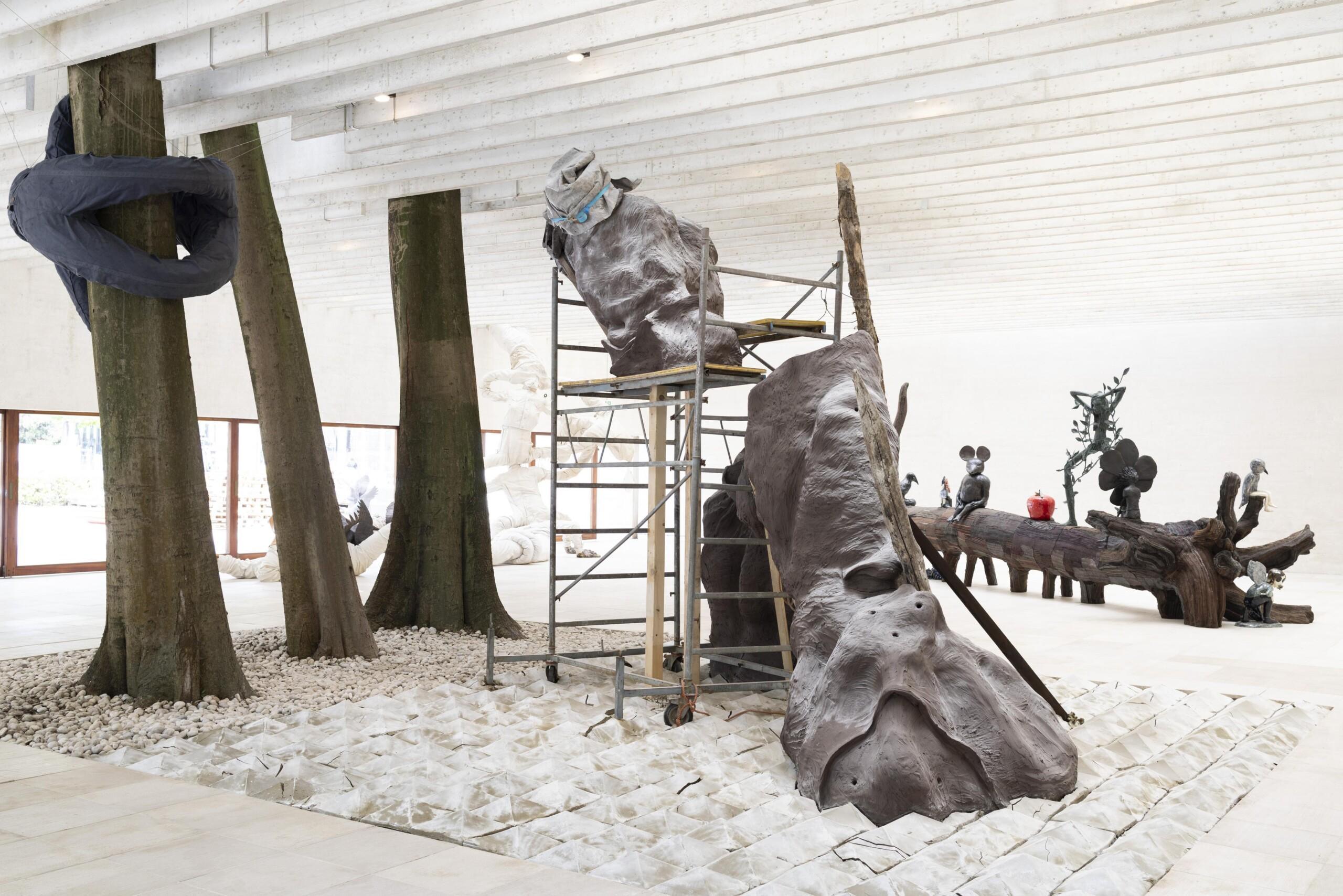
Installation view of ‘How Many Angels Can Dance on the Head of a Pin?’ at the Nordic Countries Pavilion at the 2026 Venice Biennale. Photo: Finnish National Gallery / Pirje Mykkänen
In an article series published on Frame’s blog, the invigilators of the Finnish Pavilion at the 61st Venice Biennale write about topics related to this year’s Biennale. Matilda Lehtonen reflects on how storytelling and nature’s narrative perspective are present in the Finnish and Nordic Pavilions’ exhibitions.
Contemporary art aims to explore and exhibit alternative ways for humans and nature to coexist. The ambiguity of contemporary art creates a framework in which the artist has the opportunity to set the human voice aside and make room for nature’s potential storylines. This approach to artistic exploration and discovery of nature’s narrative perspectives fits seamlessly with the theme of the 61st Venice Biennale, In Minor Keys. This year, the attention is directed towards covert registers of sound and signals from earth as well as observing the soul rather than the mind. Storytelling through a non-human lens is an essential form of approaching one of the very key themes of contemporary art, as well as the theme of In Minor Keys: shifting the attention from obvious to subtle. Artists choosing nature to be the narrator of their message can be considered a statement against the age of overstimulation and dissatisfaction we currently live in.
The Finnish and Nordic Pavilions employ alternative storytelling methods by moving away from human-centric narratives. The Pavilions share the idea of nature not being solely a landscape that provides space for a story and defines its boundaries. In the two exhibitions, Finnish Pavilion’s Aeolian Suite and Nordic Pavilion’s How Many Angels Can Dance on the Head of a Pin?, nature functions as the creator for stories and narrative worlds, and guides the viewer’s interpretations.
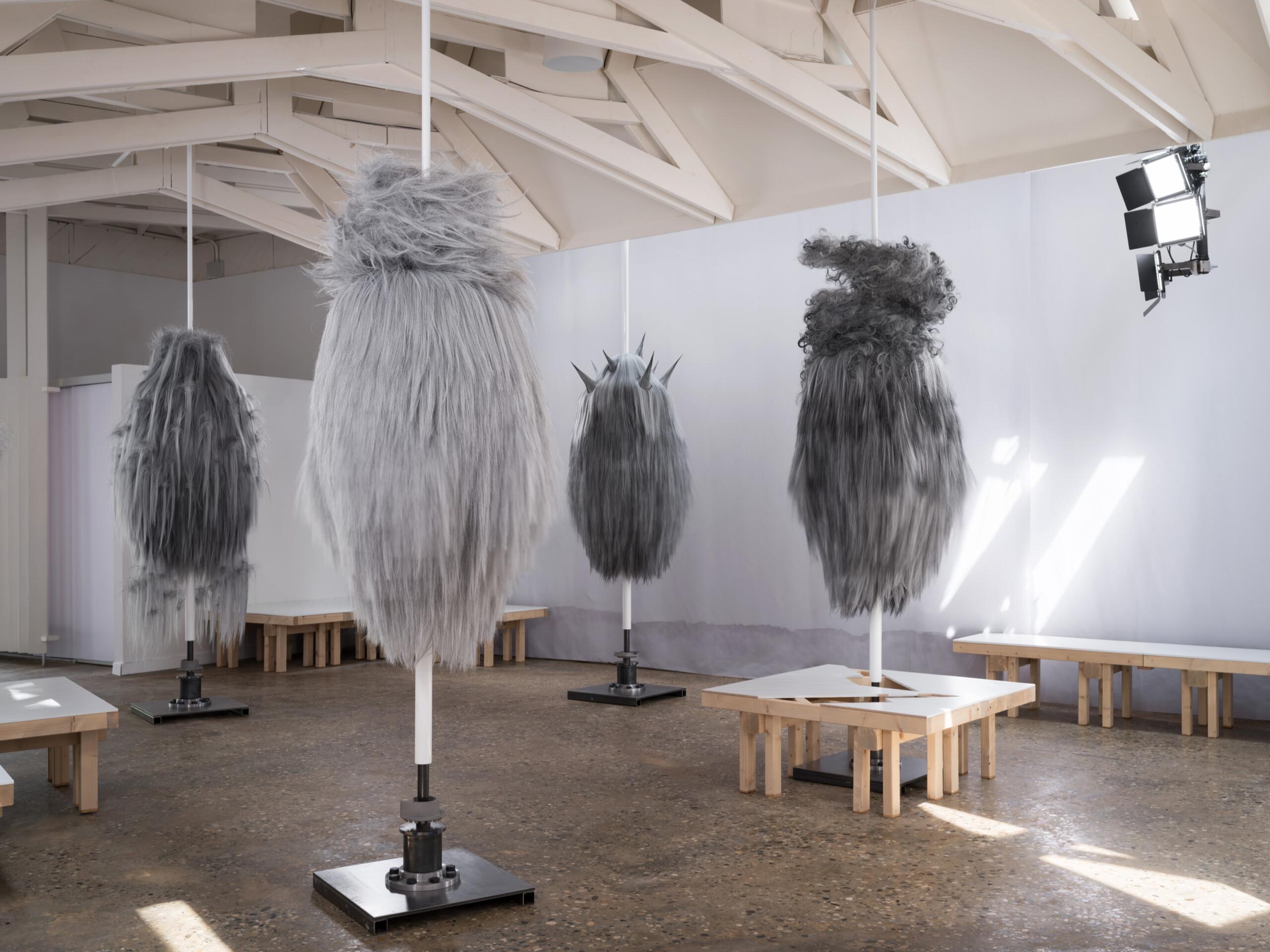
Installation view of Jenna Sutela: Aeolian Suite. Pavilion of Finland at the 61st International Art Exhibition La Biennale di Venezia. Photo: Ugo Carmeni / Frame Contemporary Art Finland
Through Jenna Sutela’s posthumanist storytelling in the Aalto Pavilion, the wind becomes not only the subject or the theme of Aeolian Suite, but also its agent and the narrator itself. In Sutela’s work, the element of nature is nearly invisible to the eye, though very dominant in the exhibition space. Curated by Stefanie Hessler, Aeolian Suite invites us to pause and focus on listening to the wind, something that humans often strive to ignore and overlook. The Biennale’s main theme can be discovered through these small yet significant observations, which help the viewer sharpen their senses to listen to nature’s way of communicating. The narrative quality of the winds is enhanced by the theatrical characters Sutela assigns to them through commedia dell’arte, through which the winds communicate using grammelot, a form of speaking without words. The work invites us to stop and listen to something inherent to nature: an uncontrolled, unpredictable narrative shaped by the natural forces.
The traditional narrative storytelling consists of a narrator, characters, and a plot. At the other extreme, ecological narrativity challenges this way of telling by presenting the story from a non-human perspective, in which the boundaries between the narrator, the characters, and the plot become blurred. Understanding ecological narrativity requires an understanding of nature. In this regard, Aeolian Suite meets the audience halfway: Drawing from commedia dell’arte, the winds resemble something human-like, though not entirely humane. However, even with the help of these characters, the work seems to grant nature the power to speak with its own voice, removing humans from the role of agents and placing them in the position of listeners and observers. The theatrical element suggests reversing the traditional roles: nature is the one performing, and people’s role in the space is surrendering.
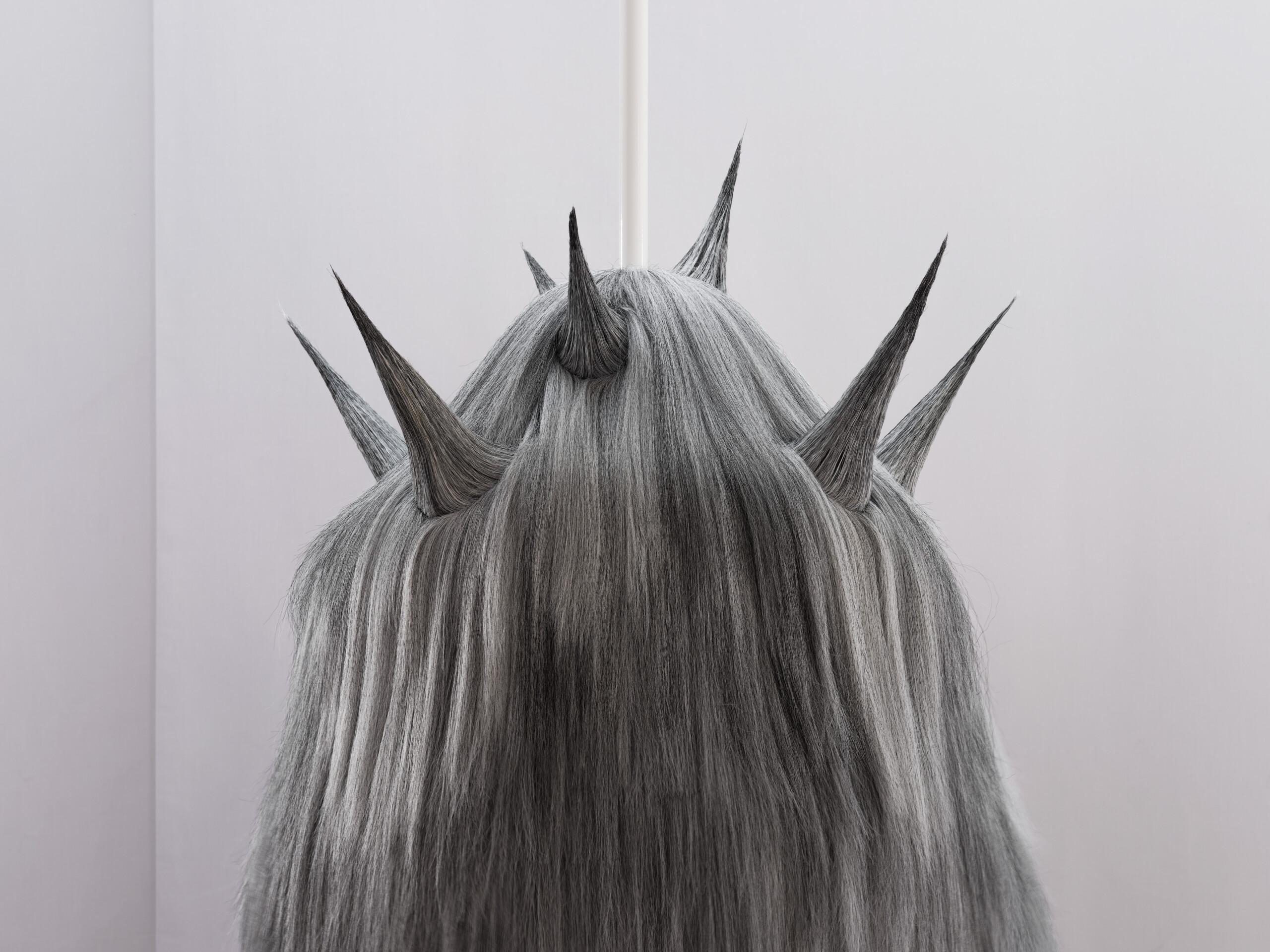
Installation view of Jenna Sutela: Aeolian Suite. Pavilion of Finland at the 61st International Art Exhibition La Biennale di Venezia. Photo: Ugo Carmeni / Frame Contemporary Art Finland
In the Finnish Pavilion, Aeolian Suite creates an environment to explore the possibilities of atmospheric elements from a narrative perspective. Human involvement is not necessarily required to demonstrate nature’s narrative relevance. The work invites the viewer to yield to something that cannot be predicted or fully controlled. The wind draws the viewer’s attention to the relationship between sensing and perceiving. What, and how, can the wind convey information to us? How does the nature narrative take a stand in today’s political and geographical climate? Ecological narrative helps us better understand these kinds of questions and to reflect on possible answers.
In the Nordic Pavilion, nature is presented through a mythical narrative, both as personal storytelling and as capturing cultural memory. The exhibition at the 61st Venice Biennale, How Many Angels Can Dance on the Head of a Pin?, combines the works of three artists, Tori Wrånes, Benjamin Orlow and Klara Kristalova. Curated by Anna Mustonen, the exhibition challenges the anthropocentric view with a gentle nudge towards more-than-human storytelling.
Mustonen’s curation of the exhibition has cleverly harnessed the Nordic Pavilion’s architecture to take part in nature-centered storytelling. Designed by the architect Sverre Fehn, the Pavilion engages multiple natural elements: trees growing inside, plenty of natural light, and surrounding greenery. How Many Angels Can Dance on the Head of a Pin? has taken advantage of this by having each artist create two works, one outside and one inside. This is the baseline for connecting the storyline of the exhibition to a natural environment, as the works engage with beyond the exhibition space itself: the natural elements of the pavilion are a vital part of the exhibition’s narrative.
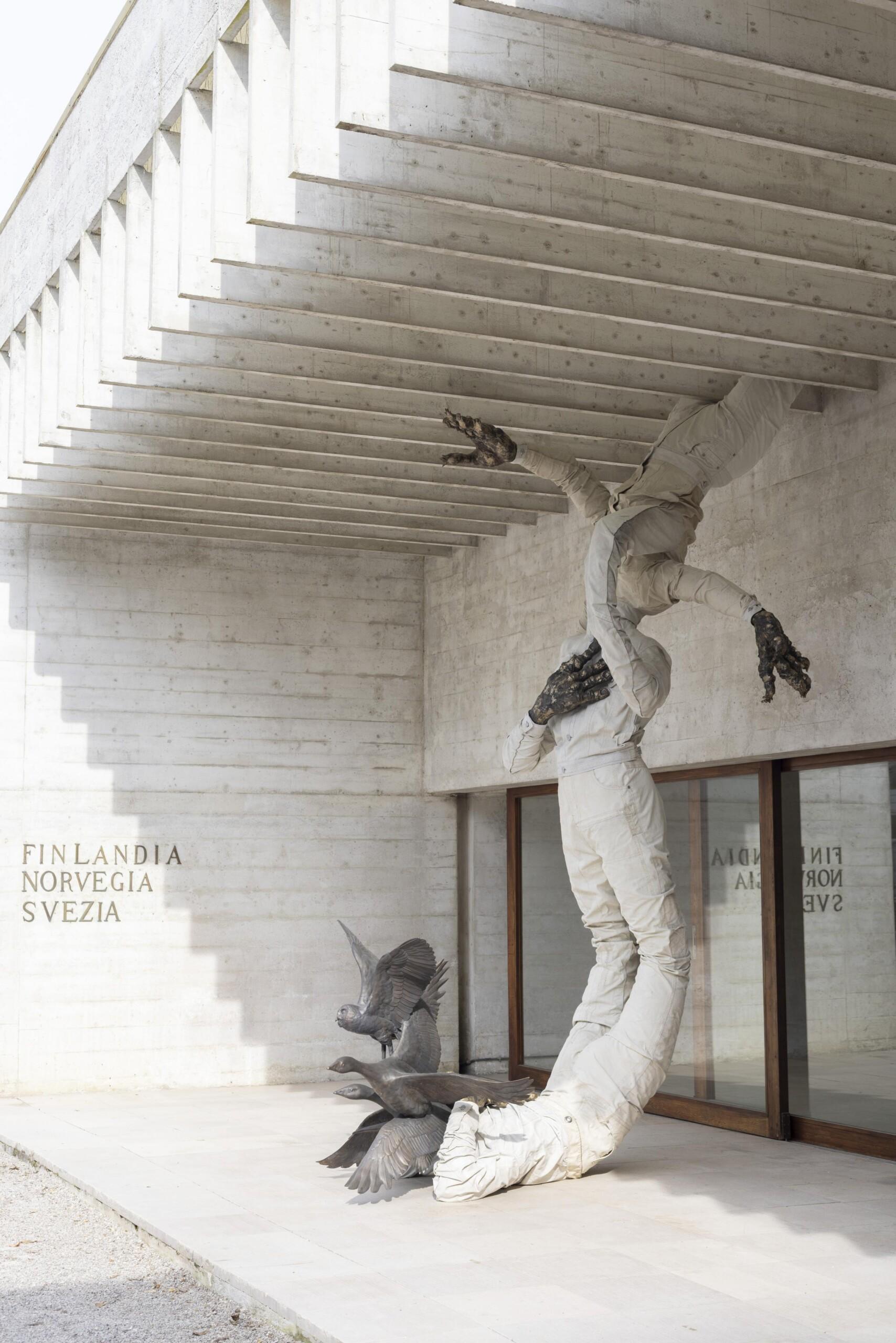
Tori Wrånes, Human Lace, 2026. Photo: Kansallisgalleria | Finnish National Gallery / Pirje Mykkänen
The best example of this could be Tori Wrånes’ works, Human Lace and Erotic Poetry by the architect, nature and me. Her work combines sound, sculpture, and performance. Her hybrid sculptural works navigate the boundaries of mythology, humanity, and nature, hungrily reaching outside the Pavilion and wrapping around the tree inside it. The sculptures blend mythological narratives with details from Wrånes’ personal past. Her body of work, the tree-hugging headless creature, and a sculpture snaking out from the Pavilion, can be interpreted as challenging the parameters of anthropocentric narratives. The multi-limbed, human-like creatures combined with mythological and nature-themed elements challenge the viewer to form new narrative frameworks — neither entirely human nor entirely real. Wrånes uses nature’s narrative as a gateway to explore stories beyond human perspectives.
Benjamin Orlow’s Ritual City uses raw clay that continuously takes shape and becomes more and more fragile throughout the exhibition. The work appears, in part, to be still constructing itself, while in other respects it seems to be disintegrating and crumbling. Drawing on the Sampo myth from Kalevala, Ritual City takes the viewer to the heart of Nordic mythology. It demonstrates that erosion, decay, or organic decomposition do not necessarily signify an end, but rather the birth of something new.
As a material, clay presents the work as earthy, natural, and even living. The work’s narrative quality is thus enhanced by its constant adaptation to time and environment. The narrative protagonist of the work is therefore not a character, but the natural process of decay. This idea draws on material agency, pointing out that materials and “things” are also active participants in shaping our world, just as humans are. Orlow’s works explore how organic materials and natural elements can shape the storylines exhibited in contemporary art.
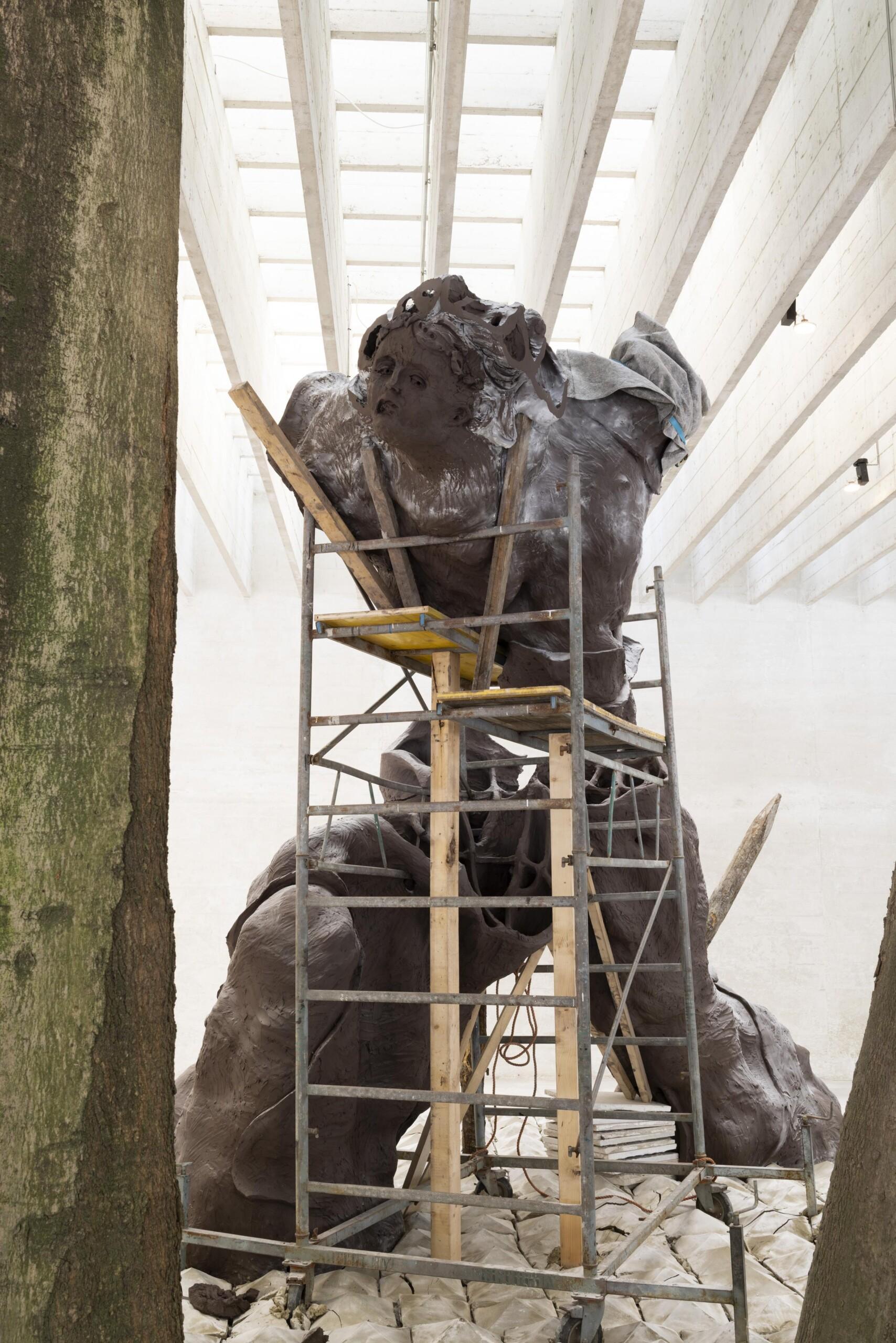
Benjamin Orlow, Ritual City. Photo: Finnish National Gallery / Pirje Mykkänen
Klara Kristalova’s Lust for Life presents a narrative of a moment frozen in time. In her work, nature itself functions almost like a person. The massive tree trunk lying across the space can be seen as a female figure who has stopped to rest or, exhausted by her surroundings, has laid down, allowing various small, mythical figures to either continue the storytelling or even emerge directly from the “mother figure”. Some of the creatures perched on the trunk are in a state of transition, being born and transforming. In Lust for Life, these beings are not only symbols, but characters with inner lives and purposes, forming alternative possibilities for the story’s continuation. Nature, therefore, does not function as a mere setting in Kristalova’s work, but rather forms a functional ensemble. Kristalova’s work presents transformation as one of the key tropes in nature’s storytelling. Lust for Life, in line with the other works in the Nordic Pavilion, reminds the viewer that the stories nature tells are not linear, but rather cyclical.
The Finnish Pavilion gives voice to the physical forces of nature, and the narrative takes the form of a physically perceptible sound that visitors can surrender themselves to. The Nordic Pavilion, on the other hand, examines the narrative of nature through memories, myths, and imaginative more-than-human storytelling. Both pavilions fundamentally challenge the anthropocentric narrative of contemporary art. They present nature as a system where everything is constantly changing, forming and decaying.
Nature’s narrative is dependent on the surroundings of the storyline: Aeolian Suite reminds us that wind cannot be heard or observed before it hits something material, like a tree, a microphone, or an instrument. How Many Angels Can Dance on the Head of a Pin? shows that the exhibition space in which nature is the narrator and the protagonist, the whole story can form around the material opportunities it has been given. To observe storytelling from the environmental perspective in contemporary art, humans need to abandon the pre-learned tropes of human-based traditional storytelling.
– Matilda Lehtonen
Student; Exhibition invigilator, Pavilion of Finland
This blog is a platform for reflecting on work, current issues and discussions in the arts by Frame staff members and other contributors. This blog post is published in English.