
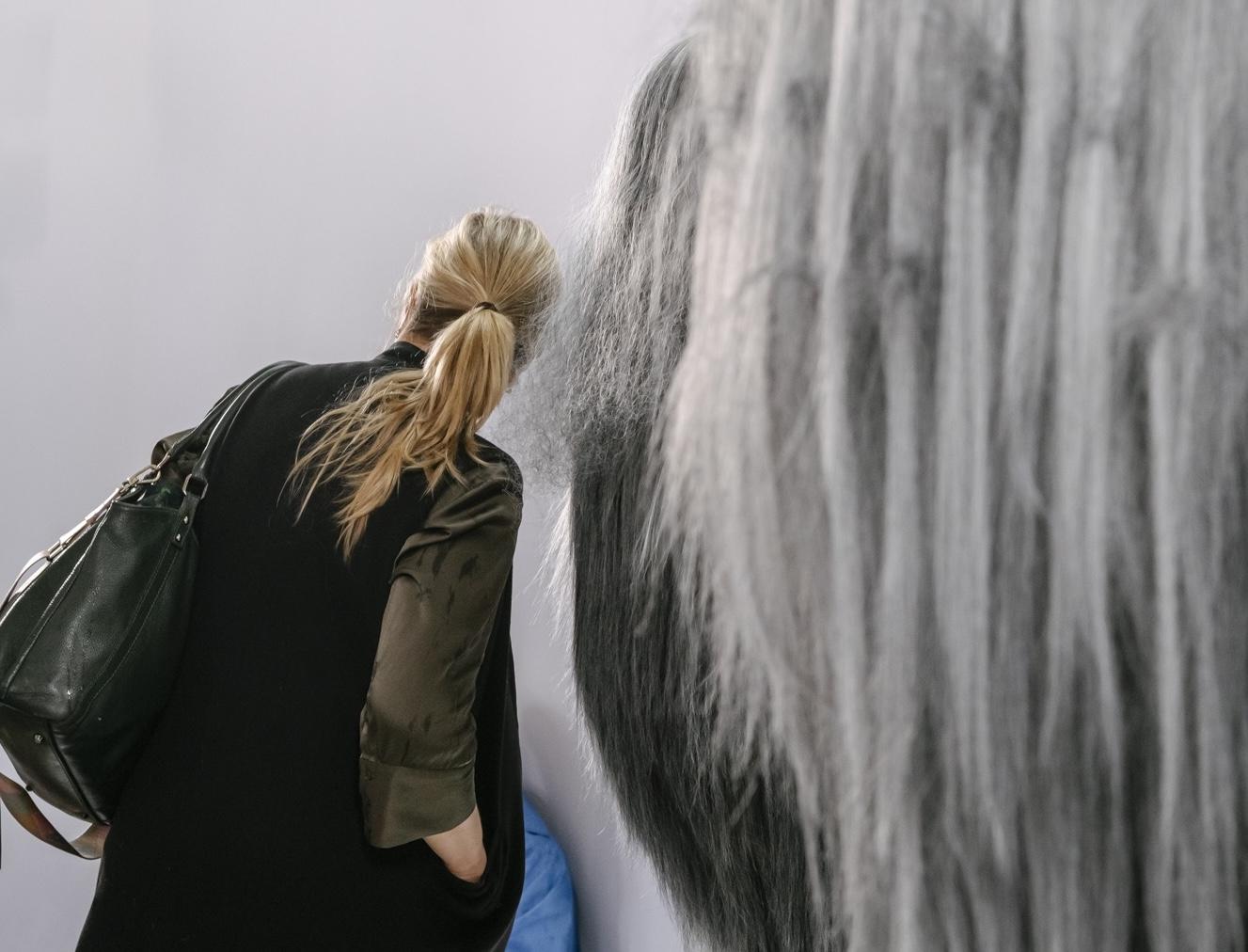
Visitor at Jenna Sutela: Aeolian Suite. Pavilion of Finland at the 61st International Art Exhibition, La Biennale di Venezia. Photo: Ginevra Formentini
In an article series published on Frame’s blog, the invigilators of the Finnish Pavilion at the 61st Venice Biennale write about topics related to this year’s Biennale. Desirée Baltanás reflects on the rhythm and sensory experience in the Finnish Pavilion exhibition, Jenna Sutela’s ‘Aeolian Suite’.
This year, the Pavilion of Finland at the Venice Biennale presents Aeolian Suite, a sculptural and multisensory artwork created by Jenna Sutela and curated by Stefanie Hessler. In this 61st edition of the Biennale, the Finnish Pavilion has become a theatrical stage displaying fluffy, grey main characters. Aeolian Suite brings to life five iterations of Venetian winds – Garbin, Scirocco, Tramontana, Bora Chiara and Bora Scura – in the format of Commedia dell’Arte and by representing them through both materiality and sound. The kinetic sculptures are intriguing and striking due to their fantastic styling made of synthetic hair.
In the exhibition, every sculpture carries air movement as the physical sensation of wind. In addition, the accompanying audio composition channels sounds – of nature, a woodwind orchestra, everyday objects like clotheslines for laundry, and a mix of blowing winds from Venice and Finland. Paraphrasing the artist, wind is usually perceived as a natural element that we often aim to conceal or suppress. Instead, Aeolian Suite is an invitation to listen, take the sound in, and enjoy what its patterns and cadence can tell us.
At first, the audience is faced with the inviting ambiance of Alvar Aalto’s Pavilion architecture and space. While the Pavilion building was originally designed to display paintings, the ceiling windows highlight the five beautifully. They stand out as if they were performing on a stage, set up on platforms and lit up by stage lights. The setup feels like an active gesture to approach the artwork with equal amounts of curiosity and active listening. Also, the benches designed to match the interior seamlessly invite one to sit down and be present with the artwork. The sound piece is enveloping.
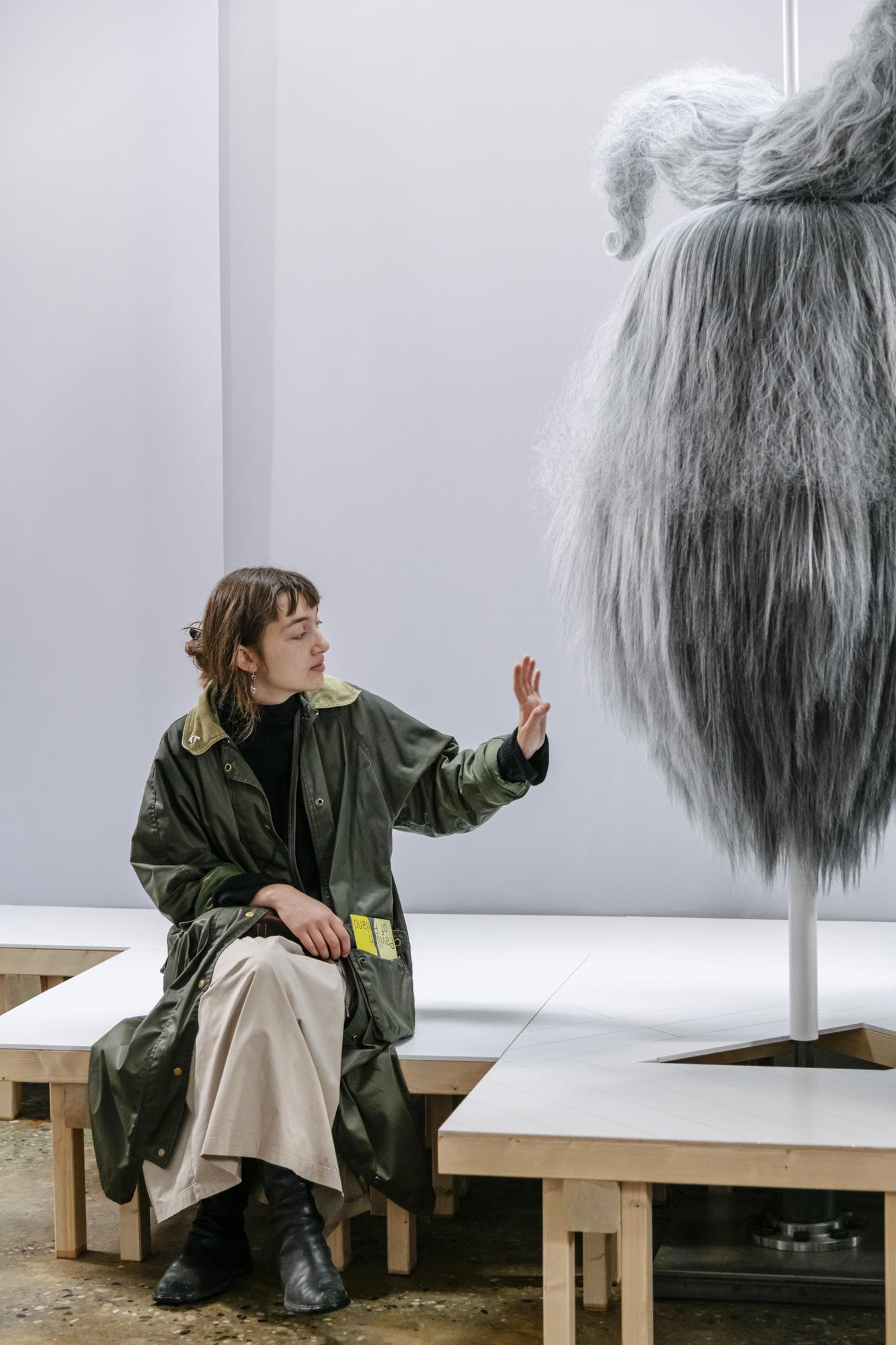
Visitor at Jenna Sutela: Aeolian Suite. Pavilion of Finland at the 61st International Art Exhibition, La Biennale di Venezia. Photo: Ginevra Formentini
While working as an exhibition attendant at the Pavilion, some visitor reactions have ranged from contemplation and silence to dancing to the work’s rhythm. Even if touching the artwork is discouraged, one of the most common instincts for visitors has been to step closer to the sculptures to hear and feel the wind from close proximity. That is how sound becomes something physical and perceptible, as the visitor is not just witnessing this reinterpretation of Commedia dell’Arte; they are also partaking in this exchange, trying to identify the sounds by discerning each of them.
That is also why the platforms on which the sculptures stand matter, as it creates a feeling of solemnity during this performance. As mentioned, the scenography refers to the theatre. The sculptures are positioned in a circle, as if they were interacting and facing each other in concert. Since the architecture includes two open doors, visitors can also move around the space in a flow – either passing through and taking the time to observe or photograph every artifact, or use the sitting space for contemplation and attentiveness. In the world of immediacy and constant mobility, Aeolian Suite gives us room to come back to ourselves and to our senses.
– Desirée Baltanás
Student, exhibition invigilator, Pavilion of Finland
This blog is a platform for reflecting on work, current issues and discussions in the arts by Frame staff members and other contributors. This blog post is published in English.