
This year, the Helsinki International Curatorial Programme (HICP) welcomes curators Noor Bhangu and Kholisile Dhliwayo to one-month curatorial residencies in Helsinki. Their residencies will take place in August and September 2026 in the HIAP residency center on Suomenlinna Island.
Noor Bhangu, based in Oslo, Norway, is a curator and scholar whose practice is rooted in relational curatorial aesthetics and practices. In 2026, she completed her PhD in Communication and Culture at Toronto Metropolitan University and York University in Tkaronto, Toronto. Her dissertation investigates cultures of sexuality within Islamic visual culture to develop a queer genealogy, linking the past to the contemporary.
Kholisile Dhliwayo is an African Australian architect, artist, and curator. His interdisciplinary practice draws on cultural practices and collective histories, particularly those of diasporas, to produce community-centered architecture, art, and installations. Kholisile is also the founder of afrOURban Inc., a non-profit organization dedicated to documenting and celebrating more accurate narratives about the spaces occupied by Black people, both in the diaspora and on the African continent.
Co-organised by Frame and HIAP – Helsinki International Artist Programme, HICP offers one-month residencies for contemporary art curators. The programme aims to allow internationally active, professional curators to connect with the Finnish contemporary art field and plan projects in collaboration with artists and partner organisations in Finland. During the last decade, the programme has hosted 35 contemporary art curators from 25 countries across 5 continents.
340 applications were received for the Open Call organised in early 2026. Selections were made by Frame’s Senior Advisor for International Networks Arvid van der Rijt, independent curator Päiviö Maurice Omwami, and independent curator Remi Vesala. HIAP’s Director Emma Beverley chaired the jury.
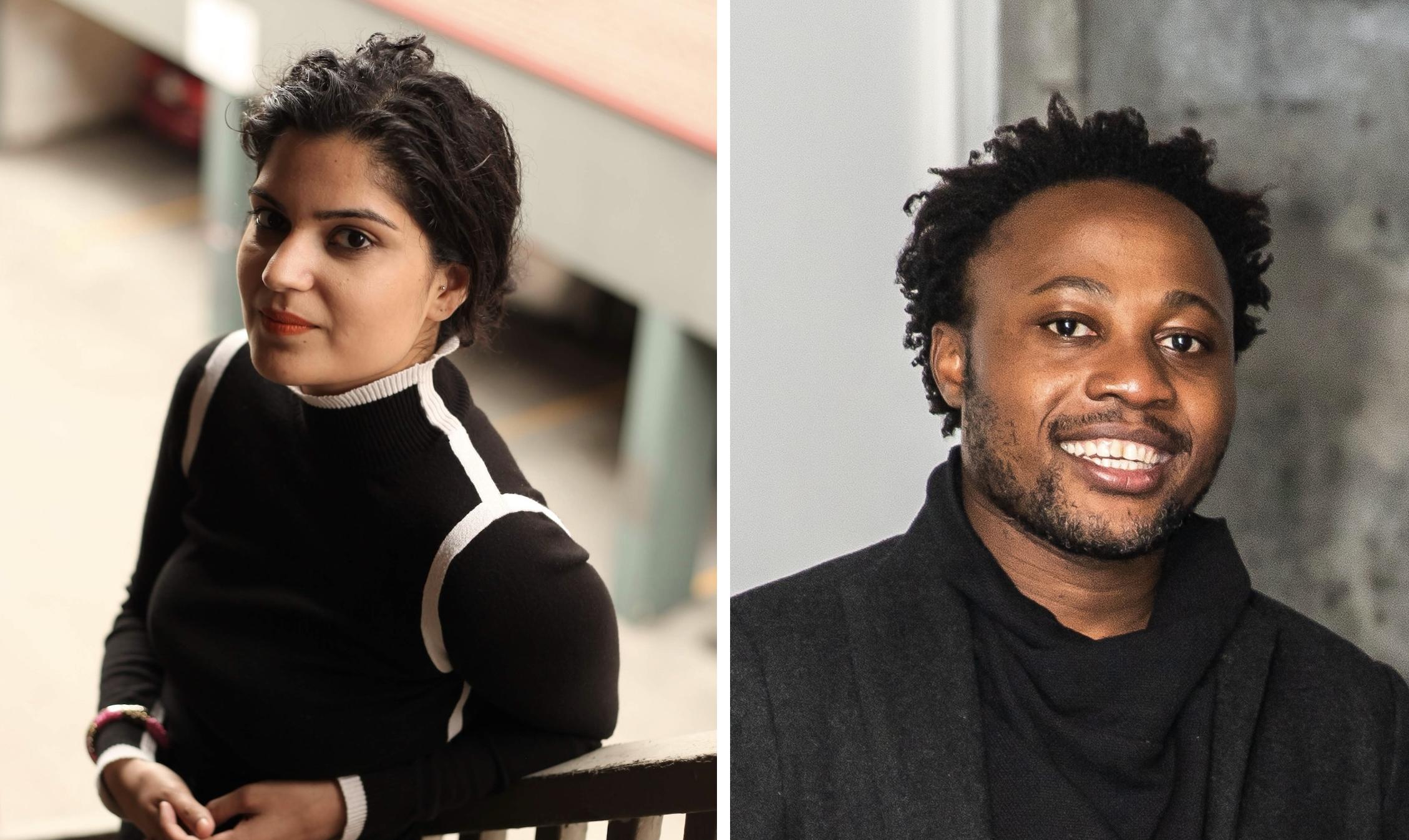
Noor Bhangu (left) and Kholisile Dhliwayo. Noor’s photo: Christina Hajjar
Biographies
Noor Bhangu
Noor Bhangu is a curator and scholar whose practice is rooted in relational curatorial aesthetics and practices. In 2026, she completed her PhD in Communication and Culture at Toronto Metropolitan University and York University in Tkaronto, Toronto. Her dissertation investigates cultures of sexuality within Islamic visual culture to develop a queer genealogy, linking the past to the contemporary. Her past curatorial projects include Homorientalism (2023) at Smack Mellon, Has My Place Forgotten Me? (2024) at Kistefos Museum, and Deviant Ornaments (2025-26) at Nasjonalmuseet, Norway.
Kholisile Dhliwayo
Kholisile Dhliwayo is an African Australian architect, artist, and curator. His interdisciplinary practice draws on cultural practices and collective histories, particularly those of diasporas, to produce community-centered architecture, art, and installations. His work includes Brooklyn Bronzes, a permanent installation at the Museum of Contemporary African Diasporan Arts (MoCADA) honouring Black Brooklynites in NYC. Kholisile is also the founder of afrOURban Inc., a non-profit organization dedicated to documenting and celebrating more accurate narratives about the spaces occupied by Black people, both in the diaspora and on the African continent. In his role with AfrOURban, he leads the Black Diasporas project, a community-driven geolocated oral mapping project that documents the experiences, spaces, and places in cities that have meaning to Black people. The Black Diasporas, project has so far taken place in Lenapehoking-NYC, Tkaronto-Toronto, Naarm-Melbourne, Boorloo-Perth, and Warrane-Sydney, with an intended Helsinki iteration.
In his architectural career, Kholisile has contributed to major civic projects, including the Canadian Senate Building, the Javits Center, and David Geffen Hall at Lincoln Center. He is a licensed architect in the United States (NY, CT, and DC) and Australia (NSW and VIC), a Harvard GSD graduate, an Adrian Cheng Fellow at the Harvard Kennedy School’s SICI program (2023–24), and a member of the New Museum’s NEW INC Year 12 cohort. His work through art, architecture, exhibition, and installation is grounded in a commitment to spatial equity and justice, embracing multiplicity and intersectionality.