
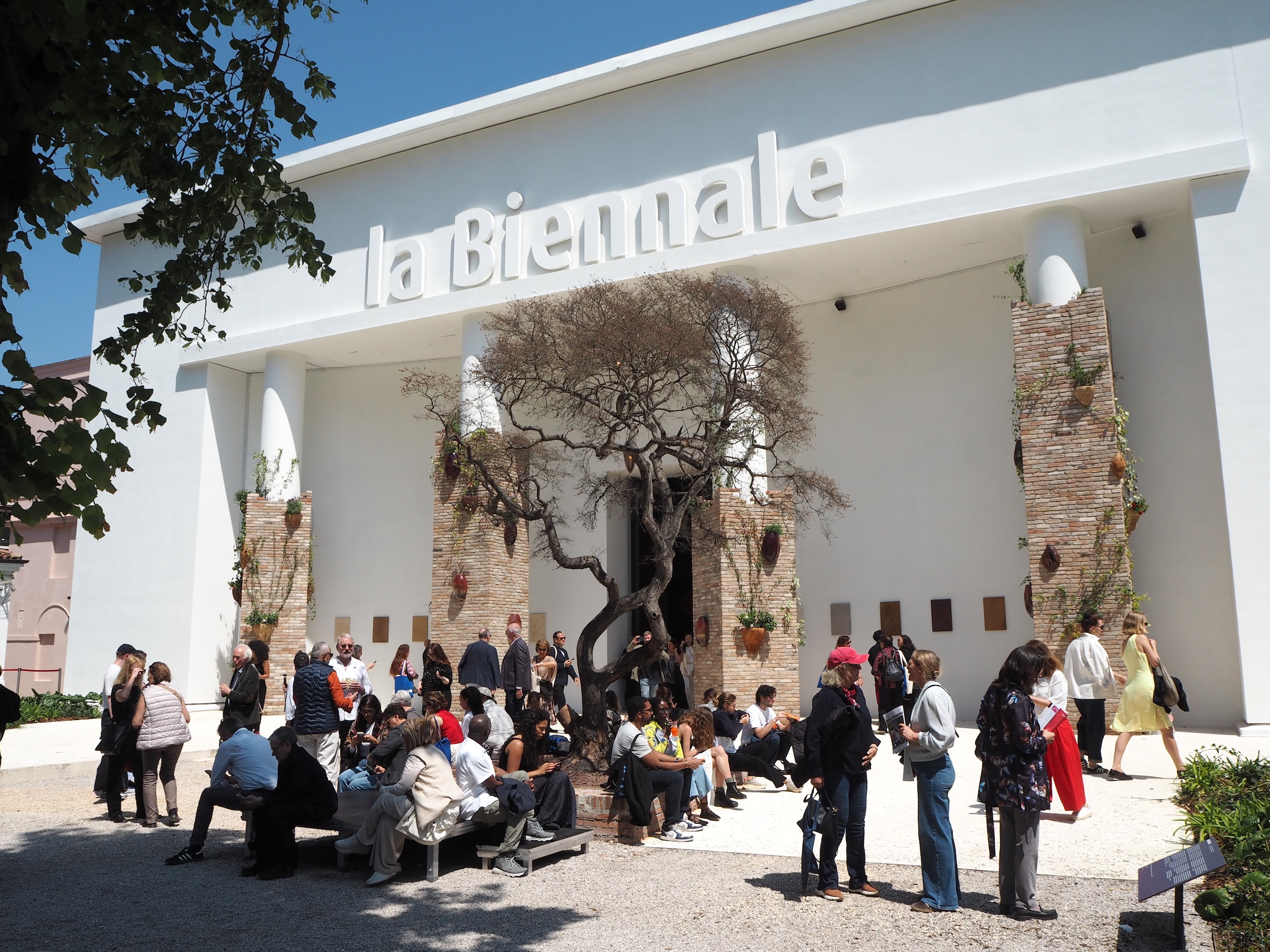
The Venice Biennale 2026 opening week in May. Photo: Rosa Kuosmanen
In addition to its contemporary art presentations, the 61st edition of the Venice Art Biennale will be remembered for the political turbulence and numerous demonstrations. In this text, Pavilion of Finland’s commissioner Juha Huuskonen reflects on the series of events and how the art community navigates going forward.
The Venice Biennale cannot escape the politics related to nation-states, since these are embedded in its core concept. An official representative of a nation – typically the Ministry of Culture – makes a decision on realising a national pavilion in Venice. As the next step, they nominate a commissioner: an organisation or a person that oversees the selection process of the artist and the curator, and takes responsibility for producing the exhibition.
Approximately 30 countries, including Finland, have a permanent national pavilion in Venice. The Finnish pavilion in the Giardini was designed by Alvar and Elissa Aalto, and celebrates its 70th anniversary this year. It is a national heritage building owned by the state of Finland and maintained by the Ministry of Education and Culture and the Ministry of Foreign Affairs in collaboration with various authorities in Venice. Frame has been the commissioner of the pavilion for the past two decades.
In Finland, as in many other countries, the Ministry respects the independence of art institutions and does not want to interfere in the selection process of the artist and the curator, or the exhibition content. Similarly, commissioners want to respect the freedom of expression of their curators and artists, and approach the pavilions as a platform for them to bring their own independent voices to the biennale.
The Venice Biennale is a kind of regular health check on the relationship between nation-states and art institutions. This system does not always work perfectly, as illustrated by what happened with the Australian and South African pavilions this year. The Australian pavilion is a good example of how pressure from the art community can lead to positive outcomes. Due to pushback from the Australian art scene, the chosen artist was reinstated after a political intervention to cancel his participation was deemed unjustified. The exhibition planned for the South African pavilion was also eventually presented independently as part of the Venice Biennale’s collateral programme after the country’s Ministry of Culture cancelled its official participation.
At a time when artistic freedom is under threat in many parts of the world, we should cherish and protect a system that emphasises the freedom of expression of the participating artists and curators, and keeps political interference at arm’s length. However, this does not mean that exhibitions are devoid of politics. On the contrary, many artists use the national pavilion as an opportunity to comment on the difficult political issues – challenging national narratives rather than embellishing them.
While politics is always present at the Venice Biennale, this year witnessed an unprecedented series of visible political actions. The Biennale opening week brought strikes, demonstrations, letters, and the closure of dozens of national pavilions – actions that gathered a record number of participants. The primary focus of these actions has been the inclusion of the Israeli and Russian national pavilions at the Biennale. At the time of writing, 240 artists, curators, and art workers participating in the Biennale have signed a letter initiated by Art Not Genocide Alliance ANGA specifically demanding the exclusion of Israel from the 2026 exhibition. Russia’s planned participation also received strong opposition from the art community and from politicians, including the Italian Minister of Culture. The political opposition in this case is grounded in the EU-wide sanctions against Russia, which in themselves should make Russian participation in the biennale impossible.
The actions that Frame and the Pavilion of Finland undertook during the opening week were a result of dialogues between Frame, the artistic team, the network of commissioners of national pavilions, and organisers of the planned actions. The Pavilion of Finland joined the strike on 8 May initiated by ANGA, Biennalocene and others, during which dozens of national pavilions closed their doors in solidarity with Palestine and cultural workers’ rights. We also joined a cohort of artists from the main exhibition and national pavilions to withdraw our participation from the Visitors’ Lion awards, initiated by the Biennale following the jury’s resignation. The Pavilion of Finland also made a donation for ARC (Artist at Risk Connection) to support their international activities. For us, these were meaningful ways to express solidarity as we believe that striving to build broader alliances is especially important during these times.
The biennale organisation keeps deflecting any responsibility by citing its commitment to freedom of expression. In a letter, published on 13 March and addressed to the Biennale by 74 artists and curators participating in the main exhibition, the signatories challenged this approach with the following statement:
“La Biennale has made a statement of neutrality, and we submit in response that allowing governments that are actively committing war crimes, atrocities and genocide to participate is not neutral. A community of nations can only exist if states are sanctioned when they egregiously violate international law and human rights. As the largest and most visible art event in the world, a position taken by La Biennale has an enormous impact. While it may be beyond the power of an exhibition to bring justice to all our concerns, there are ethical lines that can be drawn, and actions that cannot be normalized.”
Frame agrees with the statement above and urges the Biennale to respond. The Biennale should acknowledge the concerns of the arts community and make decisions regarding the national pavilions on ethical grounds. It has done so before – it blocked South Africa’s participation during the apartheid years. It should be able to make the same decision now regarding Israel and Russia.
This year’s protests could perhaps be compared to those of 1968, when major protests took place at the biennale. We find the protests to be meaningful and necessary, and we hope they lead to change in the way the biennale operates, as happened in the aftermath of the 1968 protests. The Biennale abolished its prizes, prohibited the sale of artworks, banned South Africa’s participation, and in 1973 became an autonomous organisational body, when the Italian parliament overturned a 1938 fascist-era statute that had placed the event under government control.
This year saw a record 100 countries participating in the Biennale, a significant increase from the 87 that took part in 2024. The question of whether national pavilions should withdraw from the Biennale altogether has been raised in public debate. In principle, we believe that remaining present and working in solidarity with the arts community is a more effective form of engagement and protest. At the same time, Frame, along with many other commissioners, is closely watching how the Biennale’s organisers respond to current controversies. Given the political tensions surrounding this year’s edition and the Biennale’s inadequate response, it is possible that some participating countries will choose not to return in 2028.
Politics and the Biennale are intertwined, and everyone involved must find a way to navigate them. This year made clear that the Biennale cannot ignore growing tensions and criticism if it wishes to maintain its credibility and standing within the global art community.
Despite the tensions, the opening week was marked by deep solidarity, community and a drive for action among artists, curators, art workers and national pavilion teams. At best, the Biennale acts as a platform for coming together, building joint resistance to destructive politics, and celebrating art as a means of questioning power and imagining alternatives.
– Juha Huuskonen, CEO, Commissioner of the Pavilion of Finland
This blog is a platform for reflecting on work, current issues, and discussions in the arts by Frame staff members and other contributors. This blog post is published in English and in Finnish.